You see the ads everywhere: “Lease a new car for $0 down!” It sounds like a dream deal, right? While it’s a fantastic way to get into a new vehicle without draining your savings, it doesn’t literally mean you pay nothing to drive off the lot. Let’s clear up what that popular phrase really means.
What a Zero Down Lease Really Means
The term “zero down” is a classic bit of marketing genius because it grabs your attention, but it’s often misunderstood. It doesn’t mean you can just show up, sign, and leave with a car for free on day one. It specifically refers to one thing: skipping the down payment.
A good analogy is renting an apartment. A “no security deposit” special is great, but you still have to hand over the first month’s rent. A zero down lease is the same concept. You get to avoid that big, multi-thousand-dollar down payment, but you’re still responsible for the initial costs of starting the lease.
What You Actually Pay at Signing
So, if you’re not making a down payment, what do you pay for? These initial costs are often bundled together and called “drive-off fees” or the “amount due at signing.”
Here’s a quick rundown of what you should expect to cover:
- First Month’s Payment: Your first lease payment is always due right at the start.
- Taxes: State and local sales taxes on the payment and any other government-required taxes are due upfront.
- Registration and Title Fees: These are the standard DMV fees for getting the car legally registered in your name.
- Acquisition Fee: Think of this as an administrative fee the bank charges to set up your lease account.
The real beauty of a zero down lease isn’t about getting a car for free, but about eliminating the single biggest cash expense: the down payment. This lets you keep your cash in the bank while still enjoying a brand-new ride.
Comparing Upfront Costs
The main trade-off between a zero down lease and a traditional one comes down to cash now versus cash later. When you make a down payment, you’re essentially pre-paying a chunk of the car’s depreciation to lower your monthly payments. With a zero down lease, that same amount is simply rolled into your monthly payments, making them a bit higher.
This table breaks down the key differences in how your money is structured.
Zero Down Lease vs Traditional Lease At-a-Glance
| Cost Component | Zero Down Lease | Traditional Lease (with down payment) |
|---|---|---|
| Down Payment | $0 | Typically $2,000 – $5,000+ |
| Due at Signing | First Month’s Payment + Taxes + Fees | Down Payment + First Month’s Payment + Taxes + Fees |
| Monthly Payment | Higher | Lower |
| Upfront Cash Risk | Minimal | High (Down payment is lost if the car is stolen or totaled) |
Essentially, you’re choosing between a higher monthly payment with minimal upfront cost, or a lower monthly payment that requires a significant initial investment. For many drivers, keeping that cash on hand and avoiding the risk of losing a down payment makes the zero down option incredibly appealing.
Calculating the True Cost of Your Lease
If you really want to understand zero down car lease deals, you have to learn to look past the flashy advertisement and see how your monthly payment is actually put together. It isn’t just some number pulled out of thin air; it’s a precise calculation. Once you know how the sausage is made, you can analyze any deal like a seasoned pro.
At its core, a lease payment is designed to cover two things: the amount of value the car loses while you’re driving it (depreciation), plus the cost of borrowing the money (finance charges). The dealership and the bank have their own lingo for these, but once you learn the terms, the math starts to make a lot of sense.
The Building Blocks of Your Payment
Every single lease payment boils down to just a few key factors. Get a handle on these, and you’ll see exactly where your money goes each month.
- Capitalized Cost (Cap Cost): This is the big one. It’s basically the sale price of the car, and it’s the number you should negotiate the hardest. The lower the cap cost, the lower your monthly payment will be. Simple as that.
- Residual Value: This is the leasing company’s forecast of what your car will be worth when the lease is up. It’s set by the bank, so it’s not really negotiable, but it has a massive impact on your payment. A higher residual value is good for you.
- Money Factor: Think of this as the lease’s interest rate, but it’s written as a tiny decimal (like .0025). To see what that looks like as a normal APR, just multiply the money factor by 2400.
- Lease Term: This one’s easy—it’s just the length of your lease. Most are 24, 36, or 39 months.
The heart of your monthly payment is the depreciation. It’s calculated by taking the capitalized cost, subtracting the residual value, and then dividing that total by the number of months in your lease. On top of that, they add the finance charge, which is figured out using the money factor.
A Real-World Lease Calculation Example
Let’s walk through this with a real-world example using a popular car, like a MINI. We’ll compare what a zero down lease looks like versus one with a traditional down payment.
Scenario Assumptions:
- Vehicle Price (Cap Cost): $30,000
- Lease Term: 36 months
- Residual Value: 60% of MSRP, which comes out to $18,000
- Money Factor: .00300 (this is the same as a 7.2% APR)
Calculation for a Zero Down Lease:
- Depreciation Cost: $30,000 (Cap Cost) – $18,000 (Residual) = $12,000
- Base Monthly Depreciation: $12,000 / 36 months = $333.33
- Finance Charge: ($30,000 + $18,000) x .00300 = $144.00
- Total Monthly Payment: $333.33 + $144.00 = $477.33 (plus tax)
Now, let’s see how things change if you put $3,000 down (this is often called a “cap cost reduction”).
- New Cap Cost: $30,000 – $3,000 = $27,000
- New Depreciation: $27,000 – $18,000 = $9,000
- New Base Depreciation: $9,000 / 36 months = $250.00
- New Finance Charge: ($27,000 + $18,000) x .00300 = $135.00
- New Total Payment: $250.00 + $135.00 = $385.00 (plus tax)
You can see the down payment lowers the monthly cost by more than $92, but you had to part with $3,000 right away. With the zero down lease, you keep that cash in your pocket, trading a higher payment for more financial flexibility and less risk upfront. The process is pretty straightforward, as this visual shows.
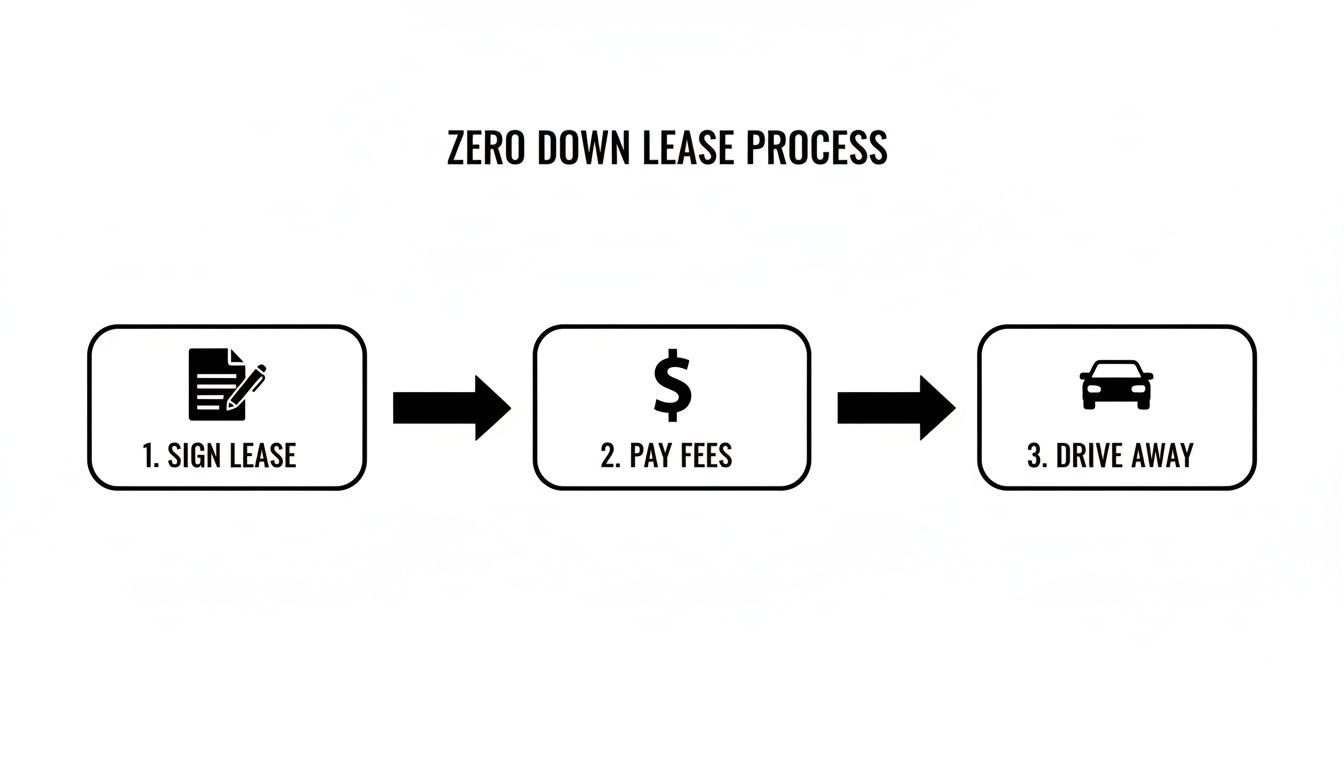
This highlights that while you skip the big down payment, you still have to take care of the standard fees and paperwork before you get the keys.
It’s also worth noting that the financial gap between leasing and buying has been shrinking. In 2025, the average monthly lease payment hit $659, which is just $23 shy of the average auto loan payment of $682. Back in 2022, that difference was a much wider $55. This shift definitely makes the decision between leasing and buying a bit more complex. You can learn more about these leasing and financing trends and what they might mean for your next car.
Weighing the Pros and Cons
A zero-down lease can feel like a magic trick—drive away in a new car without emptying your bank account. But it’s not magic; it’s a specific financial tool, and like any tool, it’s only right for certain jobs. Before you get drawn in by the allure of “sign and drive,” it’s crucial to understand what you’re gaining and what you’re giving up.
The biggest pull, of course, is keeping your cash. Instead of handing over a few thousand dollars for a down payment on a car that will immediately start losing value, that money stays right where it is—in your account. That kind of financial flexibility is a huge win, freeing up your funds for an emergency, an investment, or just peace of mind.
Then there’s the risk factor. Let’s play out a common nightmare scenario: you put $4,000 down on a traditional lease. A month later, some bad luck strikes, and the car is totaled. Your insurance will pay off the car, but that $4,000 you put down? Poof. It’s gone for good. With a zero-down lease, you haven’t put that chunk of cash on the line.
The Upside of Zero Down Leases
When you boil it down, the advantages are all about preserving your cash and protecting yourself from worst-case scenarios.
- Immediate Cash Savings: This is the most straightforward benefit. Not having to write a big check makes getting into a brand-new car a reality for people who haven’t stockpiled a large down payment.
- Protection Against Total Loss: You’re not gambling with your down payment. Nearly all leases come with Guaranteed Auto Protection (GAP) insurance, which pays the difference between what your car is worth and what you still owe if it’s totaled. This makes a large down payment essentially an unnecessary risk.
- Financial Flexibility: Having that cash on hand means you’re in control. You can use it to knock out high-interest credit card debt, beef up your emergency fund, or jump on an investment opportunity.
In short, a zero-down lease prioritizes your liquidity. It keeps your cash accessible and dramatically softens the financial blow if your car is stolen or destroyed.
But this convenience doesn’t come for free. The trade-off is baked directly into your monthly payment.
The Downside and Necessary Cautions
While keeping your savings intact is a powerful motivator, zero-down car lease deals have a flip side. The most obvious is a higher monthly payment. You’re not paying down any of the car’s depreciation upfront, so the total cost is simply divided across your monthly installments, making each one bigger.
You’re also building zero equity. Every dollar you spend is purely for the privilege of driving the car. When the lease term ends, you hand back the keys and walk away with nothing to show for those higher payments, unless you choose to buy the car at its residual value.
Perhaps the biggest hurdle is the credit requirement. Lenders see these deals as a bigger risk, so they save the best offers for applicants with strong credit. You’ll typically need a score of 700 or above to qualify for the most attractive zero-down offers. If your credit isn’t in top shape, you might not be approved or could get stuck with a high money factor (the lease’s version of an interest rate).
Should You Choose a Zero Down Lease?
To help you decide if this path is right for your situation, let’s lay out the key arguments side-by-side. Seeing the direct trade-offs can make the best choice for your wallet much clearer.
| Pros of a Zero Down Lease | Cons of a Zero Down Lease |
|---|---|
| Keep Your Cash: No large upfront payment is required, preserving your savings. | Higher Monthly Payments: Your budget must accommodate a larger payment. |
| Lower Financial Risk: Your down payment isn’t lost if the car is totaled or stolen. | Stricter Credit Requirements: The best deals are reserved for those with excellent credit. |
| Greater Flexibility: Frees up your money for other financial goals or emergencies. | No Equity Built: You are purely renting the vehicle for the term. |
| Simpler Initial Transaction: Less cash is needed to drive off the lot. | Potentially Higher Total Cost: You may pay more in finance charges over the lease term. |
Ultimately, the right answer depends on your financial priorities. If preserving cash and avoiding risk are at the top of your list—and you have the credit score to back it up—a zero-down lease is a smart, modern way to drive a new car.
Qualifying for the Best Lease Offers
Getting your hands on one of those coveted zero-down car lease deals isn’t about luck—it’s about being prepared. Lenders keep these prime offers for the most qualified applicants, so showing up with your financial ducks in a row gives you a serious edge. Think of it as an audition; you want to prove you’re reliable and a low-risk bet.
The whole qualification process is really just the dealership’s way of making sure you can handle the monthly payments over the full lease term. Because they aren’t getting a big down payment upfront to cushion their risk, they put your financial history under a much stronger microscope. This is where your credit score really comes into play.
Your Credit Score is the Key
When it comes to a zero-down lease, your credit score is the single most important piece of the puzzle. Lenders use this three-digit number as a quick snapshot of their risk. A high score signals a solid history of managing your finances responsibly, which instantly makes you a top-tier candidate for their best deals.
To even be in the running for a promotional zero-down offer, you’ll generally need a prime or super-prime credit score. While the exact number varies between lenders, a good benchmark to shoot for is 700 or higher. A score in this range is your ticket to the lowest money factors (the lease equivalent of an interest rate) and a much smoother approval process.
What if your score is a bit lower? It doesn’t automatically disqualify you, but expect some roadblocks. The lender might require a security deposit, approve you with a higher money factor, or steer you toward a traditional lease with some money down to lower their risk.
Knowing your score before you start shopping is a non-negotiable first step. You can pull your reports for free from the major credit bureaus once a year. This gives you a chance to spot and fix any errors and know exactly where you stand before you sit down with a finance manager.
Gather Your Essential Documents
Once your credit is in good shape, the next move is to get your paperwork in order. Walking into the dealership prepared shows you’re serious and dramatically speeds up the application process. It’s like having all your ingredients prepped before you start cooking—it just makes everything flow.
You’ll need to prove who you are, what you earn, and where you live. Having these documents on hand can turn what’s often a long, drawn-out affair into something quick and painless.
Here’s a simple checklist of what to bring along:
- Valid Driver’s License: This is an absolute must for proving your identity. Double-check that it’s not expired.
- Proof of Income: The lender needs confidence that you have a steady income to cover the payments. A couple of recent pay stubs or bank statements will do the trick. If you’re self-employed, be ready with your last two years of tax returns.
- Proof of Residence: A recent utility bill or bank statement with your current address printed on it works perfectly. This confirms where you live and where the car will be registered.
- Proof of Car Insurance: You can’t lease a car without full coverage insurance. Bring your current insurance card or have your agent’s contact info handy. The dealer has to verify your policy before they can let you drive away.
Showing up with a folder containing all these documents makes a strong first impression. It tells the finance team you’re organized and ready to do business, which can set a positive and professional tone for the rest of the negotiation. Being prepared doesn’t just save time; it empowers you to navigate the financing part of the deal with confidence and secure the terms you want.
How to Find and Negotiate Your Deal
Landing a great zero down car lease isn’t about luck. It’s about strategy. Most people walk onto the lot and immediately ask about the monthly payment, but that’s the last thing you should be focused on. To get a genuinely good deal, you have to shift your entire approach.
Think of it like you’re buying the car, not leasing it. Your real power comes from negotiating the one number that dictates everything else: the vehicle’s selling price, also known as the capitalized cost. Every single dollar you knock off that price is a dollar you won’t pay interest on and won’t have to cover in depreciation. Negotiate the price down first, then talk leasing.
Time Your Lease to Get the Best Price
One of the easiest ways to save big is simply knowing when to show up. Dealerships run on a tight schedule of sales goals—monthly, quarterly, and annually. Walking in right before those deadlines can give you a surprising amount of leverage. A salesperson trying to hit a bonus is a motivated salesperson.
Keep an eye out for these key moments throughout the year:
- Model Year-End: As new models roll in (typically late summer to fall), dealers get desperate to move last year’s inventory. These are brand-new cars, just a year older on paper, and they often come with the best incentives.
- Holiday Sales: Major holidays like Memorial Day, Labor Day, and the Fourth of July are hotspots for promotions directly from the manufacturers.
- End of the Year: That week between Christmas and New Year’s can be a goldmine. Foot traffic is often slow, and the sales team is making a final push to hit their annual numbers.
Ask About Hidden Manufacturer Incentives
Beyond negotiating with the dealer, you need to find out what the manufacturer is offering. Automakers often provide special discounts or rebates directly to the dealership to help them sell specific models. These aren’t always advertised to the public, but they can slash thousands off the capitalized cost.
Be direct. Ask the salesperson, “Are there any factory-to-dealer incentives or lease cash offers on this model right now?” A lower cost for the dealer means a lower price they can pass on to you.
It’s worth noting that the leasing market has tightened up. Back in 2019, leases made up nearly 34% of new car sales, but that number dropped to around 19% by 2022. This shift has had a real impact on incentives and the used car market. You can read more about these leasing market shifts on CoxAutoInc.com, and it helps to understand why the deals of today might look different than they did a few years ago.
How to Compare Lease Offers the Right Way
So, you have a few offers in hand. How do you know which one is actually the best? A low monthly payment can easily hide a terrible deal. To compare apples to apples, you have to look past the monthly number and get the full breakdown.
Insist on getting these three key figures from every dealership:
- The Capitalized Cost: What’s the final, negotiated selling price of the car?
- The Money Factor: This is just the interest rate. Make sure you get the raw decimal (e.g., .00250), not just a vague answer.
- The Residual Value: What do they predict the car will be worth at the end of the term? This is usually a percentage of the MSRP.
Once you have these numbers, you can see the truth. The offer with the lowest capitalized cost and the lowest money factor is almost always the winner. This is how you make sure your “zero-down” deal is actually as good as it sounds.
Navigating Your Lease End Options
As the end of your lease approaches, your thoughts will naturally turn from those familiar monthly payments to the big question: what’s next? Planning your exit strategy is every bit as important as the deal you struck at the very beginning. When your contract is up, you’ll find yourself at a fork in the road with three main paths to choose from.
Each one has its own set of advantages, and the right choice really hinges on your personal finances and what you need from a car going forward. Getting a firm grip on how they work puts you firmly in the driver’s seat.
Your Three Lease End Choices
When your lease term is up, the power is all yours. You’re not stuck with a single outcome. Here’s the breakdown:
- Return the Vehicle: This is the most straightforward route. You’ll schedule a final inspection, settle up any fees for extra miles or wear and tear, and simply hand over the keys. It’s a clean break, freeing you up to walk away or start a new chapter with a totally different car.
- Lease a New Vehicle: Love that new-car smell? Many people simply roll from one lease directly into another. Dealerships like Habberstad MINI often have loyalty incentives to make this an easy choice, keeping you behind the wheel of a new model with the latest features.
- Buy Your Leased Car: This option is called a lease buyout. It gives you the chance to purchase the car you’ve been driving for its predetermined “residual value.” This has become a surprisingly popular and financially savvy move for many drivers.
The Smart Strategy of a Lease Buyout
So, why would you buy a car you’ve essentially been renting? In a word: equity. If your car’s actual market value is higher than the residual value locked into your lease contract, you’re sitting on positive equity. Buying out the lease is how you claim that value for yourself.
Let’s look at an example. Imagine your buyout price is $18,000, but a quick search shows your car is selling for $21,000 on the open market. That $3,000 difference is your equity. You could buy the car and continue driving a vehicle you already know inside and out, or you could turn around and sell it for a quick profit.
This isn’t just a niche tactic anymore; it’s a growing trend. Lease buyout activity is climbing, with over half of all drivers aged 45 and older now choosing to purchase their vehicles when the lease ends. A key reason is that fewer leases are expected to end between 2023-2025, which helps keep used car values high and makes the buyout option a smart financial decision. You can explore more data and insights on 2025 lease buyout trends to see just how the market is shifting.
Before your lease is up, do a little homework on your car’s current market value. If it’s worth more than your buyout price, you’ve unknowingly built equity and are in a fantastic position to benefit from it.
Answering Your Top Questions About Zero Down Leases
Even with all the details laid out, you probably still have a few questions rolling around in your mind. That’s perfectly normal. Let’s tackle the most common ones head-on so you can walk into the dealership feeling completely prepared and confident.
Does “Zero Down” Really Mean I Pay Nothing to Drive Away?
This is easily the biggest point of confusion, and the short answer is no. “Zero down” refers specifically to one thing: you’re not making a capitalized cost reduction, which is the large, lump-sum payment that lowers the vehicle’s price at the start of a traditional lease.
You’ll still have some initial out-of-pocket costs. Think of it like moving into a new apartment—even with no security deposit, you still have to pay the first month’s rent. For a lease, this means you’re typically responsible for the first monthly payment, registration fees, taxes, and a bank acquisition fee on the day you sign. The real win is that you’re keeping a significant chunk of cash in your pocket instead of sinking it into a down payment.
How Much Does My Credit Score Matter?
It matters a lot. In fact, it’s the key that unlocks the best deals. When a lender doesn’t get a down payment, they’re taking on more risk. To offset that, they reserve their best “zero down” offers for people with excellent credit.
Generally, you’ll want a score of 700 or higher to be in the running for the most attractive promotional offers. If your score is a bit lower, you might not be shut out completely, but the lender could ask for a security deposit or give you a higher money factor (the lease’s equivalent of an interest rate) to balance their risk.
What if I Drive More Than My Mileage Allowance?
Your down payment (or lack thereof) has no connection to your mileage limit. Every lease contract spells out exactly how many miles you can drive each year—usually something like 10,000 or 12,000 miles.
If you go over that limit by the end of your lease term, you’ll pay a penalty for each extra mile. This fee is usually between $0.15 and $0.25 per mile and will be clearly stated in your contract. Be honest with yourself about your driving habits before you sign to avoid a nasty surprise down the road.
Is a “Zero Down” Offer Set in Stone, or Can I Negotiate?
You can and you absolutely should negotiate! Just because a dealer advertises a flashy “sign and drive” special doesn’t mean the numbers are non-negotiable.
The most powerful thing you can negotiate is the vehicle’s selling price (the capitalized cost). Every dollar you shave off that price directly lowers your monthly payment because there’s less depreciation to cover.
Don’t stop there. If you have great credit, you might be able to negotiate a better money factor or ask to have certain fees reduced. The best strategy is to get competing offers from a few different dealerships—it gives you incredible leverage.
Ready to see what you qualify for? The expert finance team at Habberstad MINI is here to walk you through our latest incentives and find a lease that truly works for you. Visit us online to view current MINI offers and get pre-approved today!